The post Defrosting food safely appeared first on Online Health & Safety Training Courses | ProTrainings Europe.
]]> There is a common myth that freezing kills bacteria but this is not the case. Freezing does not kill bacteria, they simply become inactive when frozen due to the low temperature, but also the lack of available water. Frozen food will usually keep for a long time, although the taste or texture of the food can deteriorate due to ice crystal damage.
When the food starts defrosting, its core temperature rises and water becomes available, providing the ideal conditions for bacteria to grow. The warmer the temperature the more active bacteria are, which is why it is recommended to defrost food slowly and safely, preferably overnight in the refrigerator. This way there is less risk of harmful bacteria growing in the food.
Once defrosted, food will spoil in the same way as if it were fresh, so handle defrosted foods in the same way as you would raw.
If you defrost any food you must do this in a way that minimises the risk of harmful bacteria growing, or toxins forming, in the food. While it is being defrosted, you must keep food at a temperature that would not result in a risk to health.
Where liquid coming from the defrosting food may present a risk to health, such as when defrosting raw meat, you must drain it off adequately. Defrosting in a fridge without correct care could result in water dripping on to other foods, causing contamination and food poisoning.
After defrosting, food must be handled in a way that minimises the risk of harmful bacteria growing or toxins forming, by keeping it in the fridge. Correct wrapping and packaging is vital.
The time it takes to defrost food varies depending on the product but make sure all food has full defrosted before cooking. For example, a chicken that is not thoroughly defrosted in the middle may never reach the required internal temperature, therefore not killing all potential bacteria.
Refrozen food has a higher risk of causing food poisoning because, when food is thawed, bacteria can multiply rapidly, particularly if at room temperature. So if the product is refrozen these bacteria will survive and when defrosted again, it is more likely that the bacteria would reach harmful levels.
However, if you cook defrosted food before refreezing, for example turning defrosted chicken into a chicken curry, any harmful bugs will be killed off, making the food safe to freeze. Any defrosted food can be stored in the fridge for up to two days before it needs to be cooked or thrown away.
To learn more about food safety visit our video online food safety course.
The post Defrosting food safely appeared first on Online Health & Safety Training Courses | ProTrainings Europe.
]]>The post Wrapping and packaging food appeared first on Online Health & Safety Training Courses | ProTrainings Europe.
]]>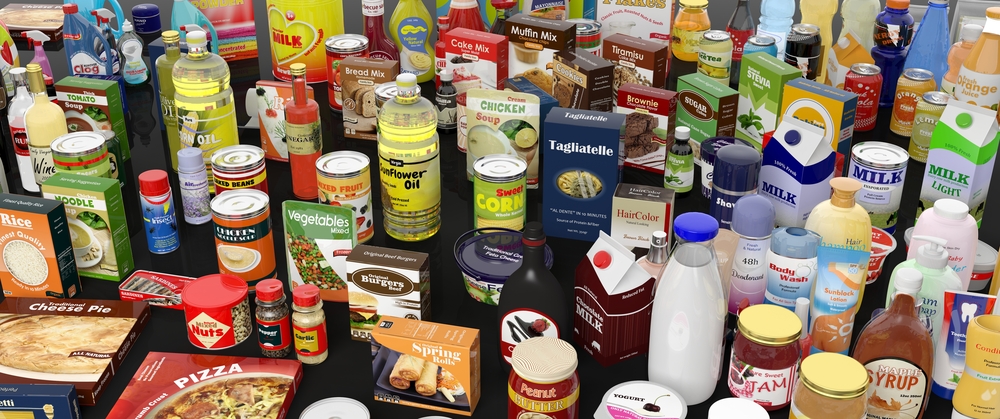 If you wrap or package food as any part of your business, including selling food to take away, then you must follow special requirements.
Materials used for wrapping and packaging food must not be a source of contamination. Only use packaging material that is specially designed for food and store this packaging in a dry place away from direct sunlight, which can break down the packaging.
You must store wrapping materials so they are not exposed to a risk of contamination. If you store packaging in a cupboard with cleaning chemicals or rubbish, this is a potential danger.
You must carry out the task of wrapping and packaging in a way that avoids contamination of products. You must make sure, where appropriate, that the container is clean and not damaged, particularly if you use cans or glass jars.
It is important that you use the correct packaging for the product you are wrapping. If a product is wet, you must avoid the potential for leakage onto other products or if you are storing a dry product, you must avoid the potential build-up of moisture.
If you re-use any wrapping or packaging material for food, it must be easy to clean and where necessary, to disinfect.
To learn more about food safety visit our video online food safety course.
The post Wrapping and packaging food appeared first on Online Health & Safety Training Courses | ProTrainings Europe.
]]>The post First aid kits for catering and food preparation appeared first on Online Health & Safety Training Courses | ProTrainings Europe.
]]>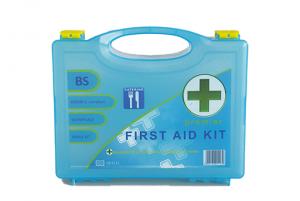 In all workplaces, there need to be adequate first aid kits. There will be trained first aiders in the business, but it is a good idea to find out who the first aiders are and what is in the first aid kit. In a kitchen, there is usually also a burns kit.
Catering first aid kits usually contain blue plasters and dressing to make them show up better if they enter the food and they have metal strips so that they can be picked up by metal detectors in the food processing process.
The size of kit you need will vary on the risk assessment you have carried out and you may need more than one kit. The kits are available in small, medium and large sizes. The first aid at work regulations gives more guidance to what you need.
Need to buy a kit? click for our range of first aid kits for catering. If you require food safety training contact us for more details. Click for more information on our Appointed Person First Aid course.
The post First aid kits for catering and food preparation appeared first on Online Health & Safety Training Courses | ProTrainings Europe.
]]>The post Food Hygiene Rating appeared first on Online Health & Safety Training Courses | ProTrainings Europe.
]]>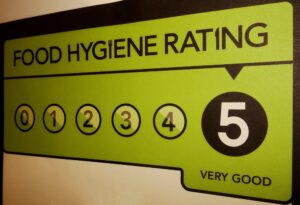 The food hygiene rating reflects the hygiene standards found at the time any given business is inspected by a food safety officer. These officers are specially trained to assess food hygiene standards.
A business can be given one of these ratings.
- Food hygiene rating is ‘0’: which means urgent improvements are necessary
- Food hygiene rating is ‘1’: which means that major improvement is necessary
- Food hygiene rating is ‘2’: which means that there are improvements necessary for the business
- Food hygiene rating is ‘3’: Means that the business is generally satisfactory
- Food hygiene rating is ‘4’: This is classified as good food premises
- The top level of food hygiene rating is a ‘5’. This means that the premises are rated as very good.
A food safety officer inspects a business to check that it meets the requirements of food hygiene legislation and he or she is from the local authority where the business is located.
At the inspection, the officer will check three main elements:
How hygienically the food is handled, how it is prepared, cooked, re-heated, cooled and stored.
The condition of the structure of the buildings, the cleanliness, layout, lighting, ventilation and other facilities,
and how the business manages what it does to make sure food is safe so that the officer can be confident that standards will be maintained in the future.
Each of these three elements is essential for making sure that food hygiene standards meet the requirements and the food served or sold to you is safe to eat.
If the top rating is not given, the officer will explain to the person who owns or manages the business what improvements need to be made and what action they can take to improve their hygiene rating.
The rating given shows how well the business is doing overall but also takes account of the element or elements most in need of improvement and also the level of risk to people’s health that these issues pose. This is because some businesses will do well in some areas and less well in others, but each of these elements checked is essential for making sure that food hygiene standards meet requirements and the food served or sold to you is safe to eat.
To get the top rating of ‘5’, businesses must do well in all three elements.
Those with ratings of ‘0’ are very likely to be performing poorly in all three elements and are likely to have a history of serious problems. There may, for example, be a lack of sufficient cleaning and disinfection, and there may not be a good enough system of management in place to check and record what the business does to make sure the food is safe.
Businesses will be given a sticker or certificate showing their rating. They can then choose to display this in a prominent position to show customers how good hygiene standards are. Customers will also be able to clarify these ratings on the Food Standards Agency’s website at food.gov.uk/ratings.
Food safety training can be taken online on our Food Safety course or why not try our diet and nutrition course.
The post Food Hygiene Rating appeared first on Online Health & Safety Training Courses | ProTrainings Europe.
]]>The post Hazard Analysis and Critical Control Point (HACCP) appeared first on Online Health & Safety Training Courses | ProTrainings Europe.
]]>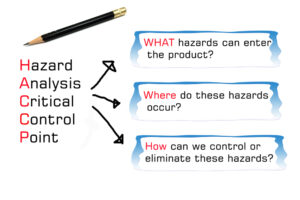 HACCP, or The Hazard Analysis and Critical Control Point System, are internationally accepted as the system of choice for food safety management. It is a preventative approach to food safety based on the following seven principles:
1 Identify any hazards that must be prevented, eliminated or reduced
2 Identify the critical control points (CCPs) at the steps at which control is essential
3 Establish critical limits at CCPs
4 Establish procedures to monitor the CCPs
5 Establish corrective actions to be taken if a CCP is not under control
6 Establish procedures to verify whether the above procedures are working effectively
7 Establish documents and records to demonstrate the effective application of the above measures
The HACCP approach provides a systematic way of identifying food safety hazards and making sure that they are being controlled day-in, day-out. This involves the following four steps: Plan, Do, Check Act.
Plan what needs to be done to maintain food safety and write it down.
Do what you plan to do to maintain food safety.
Check that you are doing what you planned to do to maintain food safety and write down what was checked and when.
Act to correct any food safety problems and write down what has been done about the problem and review to ensure the plan is effective.
There are many laws governing the safe production and sale of food. The minimum standard requires all food businesses to be kept clean and disinfected, the structure and layout of the premises must be so to protect food from risks of contamination and all food handlers must be supervised and trained as appropriate.
Article 5 of Regulation (EC) No 852/2004 requires every food business to put in place, implement and maintain a permanent and documented food safety management system based on HACCP principles.
The level of documentation and associated record-keeping will depend on the nature and size of the food business. As the Information specific businesses follow depends on the business size and type of food business they are, there are flexibility and differences in what needs to be kept.
In its simplest form, HACCP is an assessment of all the chemical, physical and biological hazards that may contaminate our food (from farm to fork) and cause illness or injury when consumed. When these hazards are identified, appropriate steps must then be taken to eliminate the hazard where possible or reduce the risk (illness or injury) to a safe and acceptable level. The law also requires certain records to be kept as proof that food safety is being managed.
The post Hazard Analysis and Critical Control Point (HACCP) appeared first on Online Health & Safety Training Courses | ProTrainings Europe.
]]>