The post Manual Handling Regulations appeared first on Online Health & Safety Training Courses | ProTrainings Europe.
]]> Manual Handling regulations are set out in The Health and Safety at Work Act, the Management of Health and Safety at Work regulations and under Manual Handling Operations Regulations 1992, which was amended in 2002.
The Health and Safety at Work Act states that every employer shall, as far as is reasonably practicable, ensure the health and safety and welfare of all employees whilst at work. Reasonably practicable is not a defined term and it is up to the employer to justify that they have taken all reasonably practicable steps.
The Health and Safety at Work Act also sets out employee duties in that they, too, must take reasonable care of themselves and others and not interfere recklessly or intentionally with anything provided for health and safety. The management of Health and Safety at Work regulations sets out more detailed duties for employees and employers.
The post Manual Handling Regulations appeared first on Online Health & Safety Training Courses | ProTrainings Europe.
]]>The post European CLP Regulations appeared first on Online Health & Safety Training Courses | ProTrainings Europe.
]]> CLP Regulations or The European Regulation (EC) No 1272/2008 on classification, labelling and packaging of substances and mixtures came into force in all EU member states, including the UK, on 20 January 2010. The main goal of the CLP regulation is to:
- Adopt in the EU the Globally Harmonised System or GHS, on the classification and labelling of chemicals
- CLP regulation is being phased in through a transitional period which runs until 1 June 2015. The regulation applies to substances from 1 December 2010 and to mixtures or preparations, from 1 June 2015
- It will apply directly in all EU member states, meaning that no national legislation is needed and will be overseen by the European Chemicals Agency or the ECHA
- CLP will replace the Chemicals (Hazard Information and Packaging for Supply) Regulations 2009, also known as CHIP regulations as of 1 June 2015
The intention of the CLP Regulation is very similar to CHIP: substances and mixtures that are placed on the market should be classified, labelled and packaged appropriately. However, because CLP adopts the GHS, in time, the same classifications and labelling will be used throughout the world.
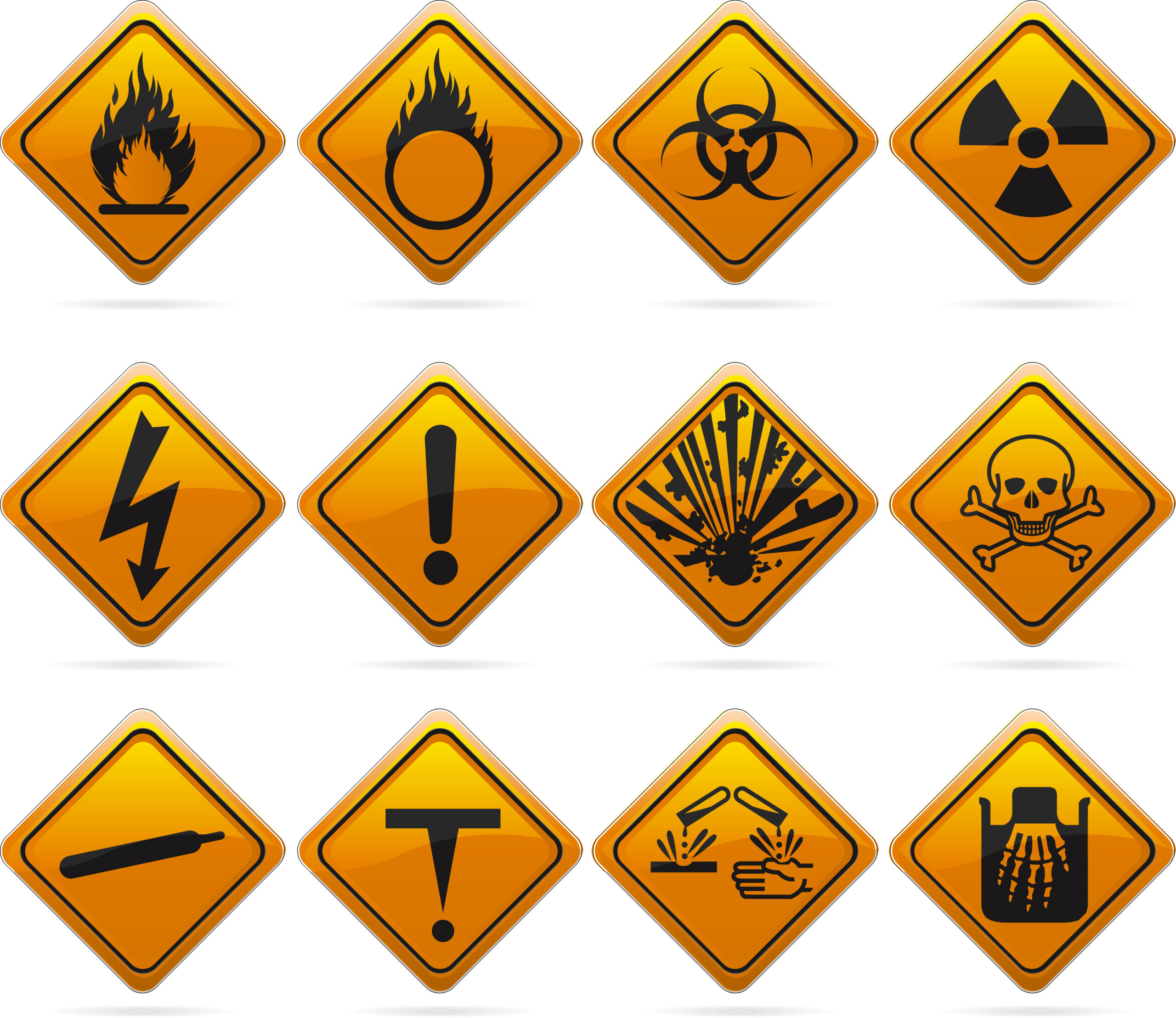
A few changes that are obvious will be the new hazard pictograms that are found on chemicals.
Although the CLP hazard pictograms are very similar to the CHIP hazard symbols, they have a new shape, design, and colour. The main symbols are as follows:
- Toxic – This can be if the substance is acute toxicity, very toxic or fatal
- Gas pressure – This shows gasses under pressure
- Irritation – Shows that the substance causes harmful skin irritation or serious eye irritation
- Flammable – The chemical is a flammable gas. Flammable liquids, solids, aerosols, organic peroxides, and self-reactive, self-heating substances that come into contact with water emit a flammable gas.
- Explosive – The product can be explosive, self-reactive or an organic peroxide.
- Harmful to the environment – This means it is harmful to the environment and aquatic life, which will cause long-term problems.
- Oxidising, the substance produces oxidising gases, oxidising liquids, and oxidising solids, which can intensify fires.
- Respiratory – The substance is a respiratory sensitiser, mutagen, carcinogen, reproductive toxicity, systemic target organ toxicity or an aspiration hazard.
- Corrosive – The corrosive substance can cause severe skin burns and eye damage.
There are some chemicals that are not covered by CLP as they have a more specialised purpose and are covered by more specific legislation.
The CLP Regulation does not apply to the following substances:
- Radioactive substances and mixtures
- Substances and mixtures are subject to customs supervision
- Non-isolated intermediaries
- Substances and mixtures for scientific research and development that are not placed on the market and are only used in controlled conditions are wasted.
The CLP Regulation also does not apply to the following chemicals which are in their finished state intended for the final user:
- Medicines
- Medical devices
- Veterinary medicines
- Cosmetics food or food additives, food flavouring and feeding stuff used in animal nutrition
The post European CLP Regulations appeared first on Online Health & Safety Training Courses | ProTrainings Europe.
]]>The post GHS Regulations appeared first on Online Health & Safety Training Courses | ProTrainings Europe.
]]> GHS regulations are an abbreviation of the Globally Harmonised System of Classification and Labelling of Chemicals. GHS is not a law. It is an international agreement.
There are different laws worldwide on how to identify the hazardous properties of chemicals; this is known as ‘classification’; they also cover how information about these hazards is passed to users (through labels and safety data sheets for workers).
This can be confusing because the same chemical can have different hazard descriptions in different countries. For example, a chemical could be labelled as ‘toxic’ in one country but not in another. This confusion also acts as a barrier to international trade.
The Earth Summit held in Rio de Janeiro in 1992 and the World Summit held in Johannesburg in 2002 recognised this as an important global issue.
Given the expanding international market in chemical substances and mixtures, to help protect people and the environment and to facilitate trade, the United Nations has therefore developed a ‘Globally Harmonised System’ (GHS) on classification and labelling.
The GHS is a single worldwide system for classifying and communicating the hazardous properties of industrial and consumer chemicals. GHS sits alongside the UN ‘Transport of Dangerous Goods’ system.
The UN brought together experts from different countries to create the GHS to have the same criteria for classifying chemicals according to their health, environmental and physical hazards and hazard communication requirements for labelling and safety data sheets.
The UN GHS is not a formal treaty but instead is a non-legally binding international agreement. Therefore, countries (or trading blocs) must create local or national legislation to implement the GHS.
The UN GHS aims to ensure that information on the hazardous properties of chemicals is available worldwide to enhance the protection of human health and the environment during the handling, transport and use of chemicals. GHS also provides the basis for harmonising regulations on chemicals at national, regional and worldwide levels. This is important for facilitating trade. At a more basic level, GHS also aims to provide a structure for countries that do not yet have a classification and labelling system.
The UN anticipates that once fully implemented, the GHS will:
- Enhance the protection of human health and the environment by providing a system for hazard communication that is comprehensible throughout the world
- Provide a recognised framework for those countries without an existing system
- Reduce the need for testing and evaluation of chemicals
- Facilitate trade in chemicals whose hazards have been properly assessed and identified internationally.
The UN work programmes continue to develop and refine the UN GHS. In the long run, GHS and CLP should make the classification of mixtures easier, cheaper, and more accurate and allow for more flexibility on the part of the classifier.
The post GHS Regulations appeared first on Online Health & Safety Training Courses | ProTrainings Europe.
]]>The post COSHH Regulations appeared first on Online Health & Safety Training Courses | ProTrainings Europe.
]]>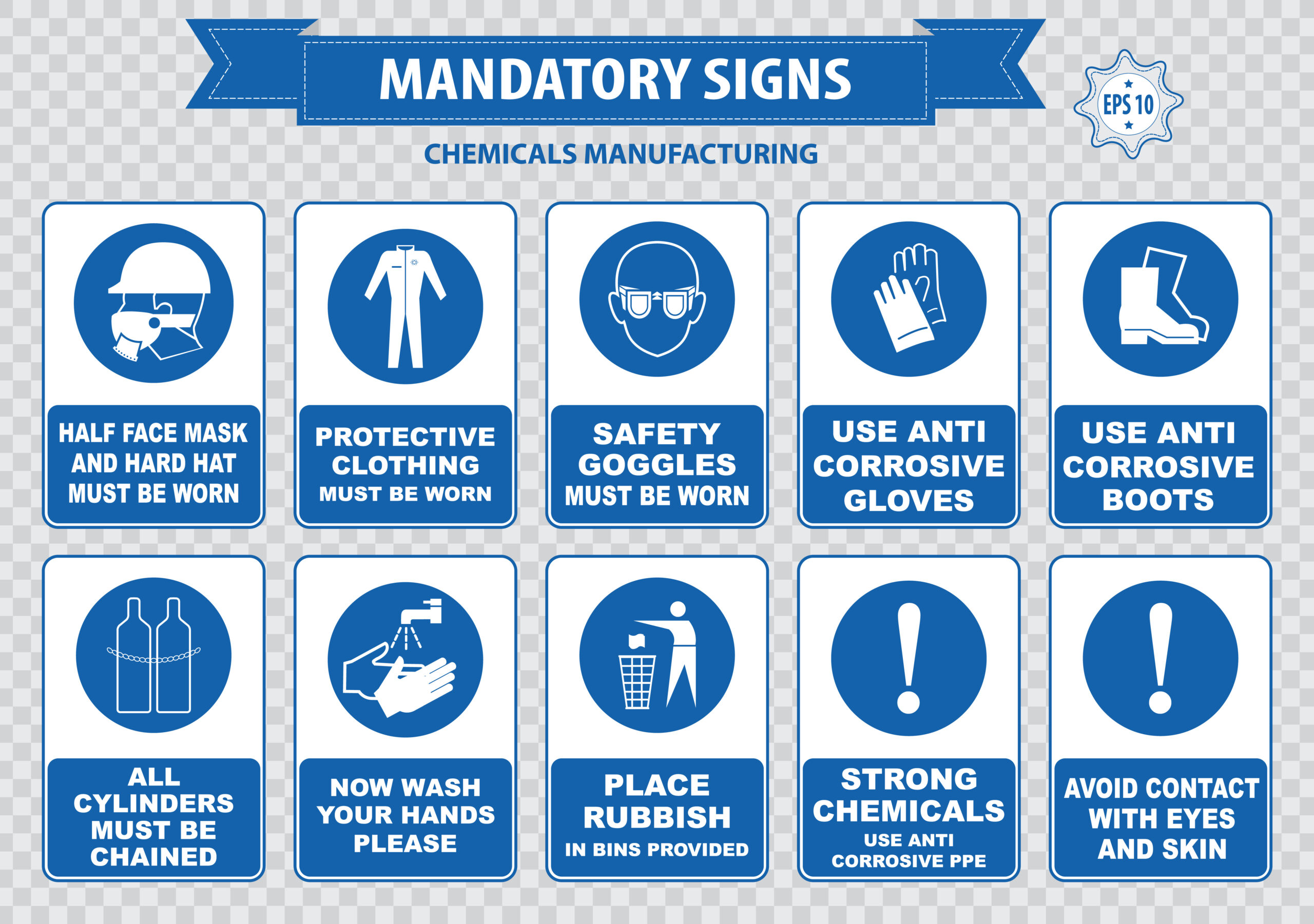 COSHH Regulations, or the full name, The Control of Substances Hazardous to Health Regulations 2002, provide information on what the law requires and advice on completing COSHH assessments. You must ensure that you are correctly assessing risks – high and low. These regulations are updated from time to time, and they were amended in 2004 and came into force in 2005.
The occupational use of materials is regulated under the Control of Substances Hazardous to Health (COSHH). COSHH is the law that requires employers to control substances that are hazardous to health. The law and guidance show how you can prevent or reduce workers’ exposure to hazardous substances by:
- Finding out what the health hazards are
- Deciding how to prevent harm to health (risk assessment)
- Providing control measures to reduce harm to health
- Making sure they are used
- Keeping all COSHH control measures in good working order
- Providing information, instruction and training for employees and others
- Providing monitoring and health surveillance in appropriate cases
- Planning for emergencies
Most businesses use substances or products that are mixtures of substances. Some processes create substances. These could cause harm to employees, contractors and other people.
Sometimes, substances are easily recognised as harmful. As a new technology or work process is designed, the risks of exposure associated with materials or substances may not be fully understood and extra precautions may be needed.
The post COSHH Regulations appeared first on Online Health & Safety Training Courses | ProTrainings Europe.
]]>The post First Aid equipment and what first aiders are required appeared first on Online Health & Safety Training Courses | ProTrainings Europe.
]]>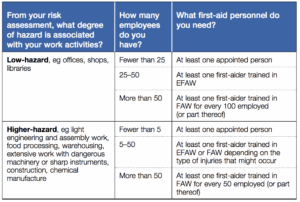 When deciding on how many first aiders are required, you must carry out a risk assessment. This table gives some basic guidance. The regulations that apply to first aid provision are the First Aid at Work Regulations 1981. The table shows FAW and EFAW but there are other qualifications that may be accepted. The first aid regulations also specify the contents of a first aid box and first aid rooms. Contact us at ProTrainings for more information.
The post First Aid equipment and what first aiders are required appeared first on Online Health & Safety Training Courses | ProTrainings Europe.
]]>The post Health and Safety At Work Act 1974 appeared first on Online Health & Safety Training Courses | ProTrainings Europe.
]]> Health and Safety at Work Act 1974 is the primary piece of legislation covering occupational health and safety in Great Britain. The Health and Safety Executive, with local authorities and other enforcing authorities are responsible for enforcing the Act and a number of other Acts and Statutory Instruments relevant to the working environment.
The basis for the act is to ensure that all workers have a right to work in places where risks to their health and safety are properly controlled.
Health and safety is about stopping you getting hurt at work or ill through work. Your employer is responsible for health and safety, but you must help.
The Act sets out the general duties which employers have towards employees and members of the public, and employees have to themselves and to each other.
These duties are qualified in the Act by the principle of ‘so far as is reasonably practicable’. In other words, an employer does not have to take measures to avoid or reduce the risk if they are technically impossible or if the time, trouble or cost of the measures would be grossly disproportionate to the risk. We will look at this term later in this course.
What the law requires here is what good management and common sense would lead employers to do anyway: that is, to look at what the risks are and take sensible measures to tackle them.
The Management of Health and Safety at Work Regulations 1999 generally make more explicit what employers are required to do to manage health and safety under the Health and Safety at Work Act. Like the Act, they apply to every work activity.
The main requirement on employers is to carry out a risk assessment. Employers with five or more employees need to record the significant findings of the risk assessment.
The post Health and Safety At Work Act 1974 appeared first on Online Health & Safety Training Courses | ProTrainings Europe.
]]>The post Reasonably Practicable appeared first on Online Health & Safety Training Courses | ProTrainings Europe.
]]> Reasonably practicable is a word used in health and safety and if you have completed any Health and Safety related course you are probably familiar with the words “so far as is reasonably practicable” during this short video we are going to describe what is actually meant by these words in the context of Health and Safety at Work.
Where a risk assessment has identified a risk the first consideration is the risk itself, how severe is the risk, what is the likelihood of an incident and the number of people who are exposed to the risk, this is set at the cost both in time and financial terms, the effort and materials required to put control measures in place to reduce the risk.
For example, where there is a high risk that a large number of people are exposed to it would be deemed reasonably practicable for the employer to go to substantial expense and time to reduce the risk. Where the risk is deemed to be very low it would not be reasonably practicable to ask the employer to spend a large amount of money putting control measures in place to reduce it.
It may seem obvious to everybody that spending a few pounds to prevent a serious injury to a large number of people is reasonably practicable and spending thousands putting in control measures to reduce the risk of someone cutting their finger is not reasonably practicable, however there are no set rules and what is reasonably practicable will vary from one business to another, in most situations where a dispute arises the decision as to whether or not it was reasonably practicable will be made in a court of law. It is important to remember that the judgement is an objective one based on the health risks and not the size or financial position of the employer.
The post Reasonably Practicable appeared first on Online Health & Safety Training Courses | ProTrainings Europe.
]]>The post Provision and Use of Work Equipment regulations 1998 – PUWER appeared first on Online Health & Safety Training Courses | ProTrainings Europe.
]]>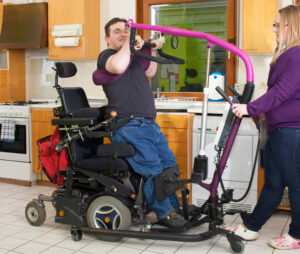 PUWER is the abbreviation for Provision and Use of Work Equipment regulations 1998. These regulations cover any equipment which is used by an employee at work from lifting equipment, motor vehicles and circular saws to knives, ladders and laptops. If employees are allowed to provide their own equipment it will also be covered by PUWER and it will be the employer’s responsibility to make sure it complies.
The comply with the regulations you must ensure that the work equipment provided meets the requirements of PUWER, it must be used for suitable purposes and under the right conditions, to ensure that people’s health and safety is not put at risk.
Equipment must be maintained and inspected, to make sure that it continues to be safe for use. Inspections should be carried out by a competent person and a record kept which should be updated at the next inspection. The risks identified during your risk assessment relating to using equipment should be eliminated or controlled when possible as far as is reasonably practicable by providing suitable guards, using protection devices, using control systems such as emergency stop buttons and personal protective equipment and providing adequate instruction and training.
Machinery safety is vital. Working with machinery can be dangerous, moving parts of machinery can trap or draw parts of the body, sharp edges can cause cuts and serious injuries, sharply pointed parts could stab or puncture the skin. Machines that emit steam or water could cause scalds or burns and electrical safety can cause electric shock and burns. Before use, mechanical equipment should be checked to make sure that it is free from defects, complete with all safeguards fitted. Training and instruction have been provided and ensure the appropriate use of safety equipment and supervision where required.
Make sure that individuals using the equipment have the knowledge and risk awareness to use the equipment and that they are physically suited to the task. When planning under PUWER, consider the work area that the equipment will be used in. Is it clean tidy and clear of obstructions to avoid any slips, trips or falls and is it well lit? Consider using signs or barriers.
Mobile work equipment that is used for carrying people must be fit for purpose and used in a safe manner in a safe environment, where you can ensure stability and make sure that there is no risk of it rolling over or presenting a danger to the people being carried, the operator or anyone else.
The other regulation linked to PUWER is the Lifting Operations and Lifting Equipment Regulations.
The post Provision and Use of Work Equipment regulations 1998 – PUWER appeared first on Online Health & Safety Training Courses | ProTrainings Europe.
]]>The post Lifting Operations and Lifting Equipment Regulations – LOLER appeared first on Online Health & Safety Training Courses | ProTrainings Europe.
]]>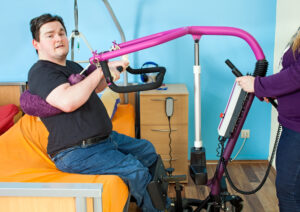 LOLER is the abbreviation for Lifting Operations and Lifting Equipment Regulations. These regulations place responsibilities on individuals and companies who own, operate or have control over lifting equipment, whether the equipment is actually owned by them or not.
LOLER and Provision and Use of Work Equipment regulations 1998 require that all equipment used for lifting during work activities is appropriate and fit for purpose and that all lifting operations must be properly planned by a competent person under appropriate supervision. They must always be carried out in a safe manner. Many of the regulations relating to machinery we have already covered in our PUWER video course. Risks must be managed and controlled to avoid any injury or damage. This can be done by planning the lift properly, ensuring that the people who are using the lifting equipment are competent, supervised and trained.
When risk assessing is involved in using lifting equipment and meeting the requirements of LOLER you need to consider the type of load being lifted, its weight shape and what it is. You also need to assess the risk of a load falling and striking a person or object and the consequences of the lifting equipment failing or falling over when in use.
Ergonomic risks should be considered. This takes into account the size and shape of a human body to ensure that operating positions, working heights and reach can be adapted to accommodate the intended operator. No undue force, stretching or reaching should be required. All new lifting equipment whether manual or motorised lifting equipment needs to satisfy certain essential health and safety requirements as set by the Article 100a Product Safety Directives. Existing equipment does not necessarily have to meet the same level of protection but this does depend on the degree of risk. The greater the risk is the greater the measures you need to take to control the risk.
LOLER applies to many different types of lifting equipment from vehicle inspection hoists, a passenger lift in an office block, automated storage and retrieval systems, vehicle tail lifts or bath hoists used for lifting residents into a bath in a nursing home.
All lifting equipment should be strong and stable enough for the intended load. It must be clearly marked to indicate its safe working load for each configuration. Accessories for lifting should be marked in such a way that it is possible to identify the characteristics necessary for their safe use. Lifting equipment designed for lifting persons must be appropriately and clearly marked to this effect and equipment that has not been designed for lifting people must clearly state this to ensure that it is not used in error.
Hoist’s slings and bath hoists used to lift people, standing and raising aids, ceiling track hoists, and the slings and all other accessories attached to lifting devices should be thoroughly examined by competent people at least every six months. If a unit is moved to another location or is involved in an incident which may have caused damage then inspection is required before it is put to use. All other lifting equipment should be examined at least annually.
Also, the standard for Hoists for the transfer of disabled persons, BS EN10535, states that the hoist should be load-tested to its maximum load at least every 12 months.
Finally, it is the employer’s responsibility to ensure that a competent person carries out the servicing. They must also keep records of the examinations and service reports for inspection by the Health and Safety Executive if an accident ever did occur.
The post Lifting Operations and Lifting Equipment Regulations – LOLER appeared first on Online Health & Safety Training Courses | ProTrainings Europe.
]]>The post First Aid at Work regulations appeared first on Online Health & Safety Training Courses | ProTrainings Europe.
]]> First Aid at Work regulations come under the Health and Safety (First-Aid) Regulations 1981 and require employers to provide adequate and appropriate equipment, facilities and personnel to ensure their employees receive immediate attention if they are injured or taken ill at work.
These Regulations apply to all workplaces including those with less than five employees and to the self-employed.
What is ‘adequate and appropriate’ will depend on the circumstances in the workplace. This includes whether trained first-aiders are needed, what should be included in a first-aid box, first aid equipment required and if a first aid room is required. Employers should carry out an assessment of first-aid needs to determine what to provide.
The Regulations do not place a legal duty on employers to make the first-aid provision for non-employees such as the public or children in schools. However, Health and Safety Executive strongly recommend that non-employees are included in an assessment of first-aid needs and that provision is made for them.
Employers are required to carry out an assessment of first aid needs. This involves consideration of workplace hazards and risks, the size of the organisation and other relevant factors, to determine what first-aid equipment, facilities and personnel should be provided.
If you are self-employed you are required to ensure you have such equipment, as may be adequate and appropriate in the circumstances, to provide first aid to yourself while at work.
There are special requirements for first aid provision in sectors like offshore work or diving.
You can get full guidance from the first aid approved code of practice which we have put a link on the student download area of this course.
This guidance is for employers and it sets out what you need to do to address the first-aid provision in the workplace.
It provides guidance on:
- Managing the provision of first aid (first-aid kit, equipment, rooms etc)
- Requirements and training for first-aiders
- Requirements for appointed persons
- Making employees aware of first-aid arrangements
- First aid and the self-employed cases where first-aid regulations do not apply.
- The First Aid Regulations state that where an employer provides first-aiders in the workplace, they should ensure they have undertaken suitable training, have an appropriate first-aid qualification and remain competent to perform their role.
Typically, first-aiders will hold a valid certificate of competence in either first aid at work (FAW) or emergency first aid at work (EFAW). EFAW training enables a first-aider to give emergency first aid to someone who is injured or becomes ill while at work. FAW training includes EFAW and also equips the first-aider to apply first aid to a range of specific injuries and illnesses.
The post First Aid at Work regulations appeared first on Online Health & Safety Training Courses | ProTrainings Europe.
]]>