The post What is a hazard? appeared first on Online Health & Safety Training Courses | ProTrainings Europe.
]]>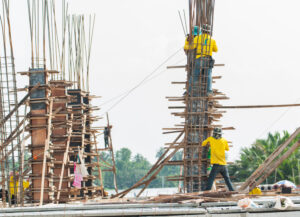 A hazard is anything with the potential to cause harm, like a cutting machine. The potential severity of harm from the machine could be a minor cut needing plaster if you knock into it or a serious cut or amputation if you get a hand caught in it.
Some examples of hazards and the injury that could occur are:
- Temperature – Heat stress, sunburn, melanoma, hypothermia, freezer burn, frostnip or frostbite
- Ventilation & humidity – headaches, nausea, tiredness, dry or itchy eyes
- Manual Handling – Back injury, musculoskeletal disorders, hernia and many other injuries
- Work with Display screen equipment (DSE) – Musculoskeletal disorders, eyestrain or eye soreness, headaches and blurred vision, fatigue, occupational stress.
- Tripping and slipping – Injury to any part of the body depending on how you fall and what you are carrying
- Work at heights – Fall of the persons, suspension trauma or objects falling and hitting someone on the ground
- Obstructions – Striking against it, tripping over it as well as blocking emergency escape routes
- Poor Stacking or Storage – Falling materials, back injuries, falls during retrieval.
- Repetitive movements – Musculoskeletal disorders
- Fire and explosion – Burns, health effects of smoke inhalation, exposure to hazardous substances, toxic fumes, psychological trauma
- Hazardous chemical substances – Acute and chronic health effects, allergies. When we know the hazards, we can work out the risk factors and what control measures we need to adapt to reduce or eliminate the risk.
Finally, hazards in the workplace can also cause harm to the environment. This can be things like chemicals getting into to rivers or dust leaving a factory.
We offer a full range of First Aid Equipment and CPR Manikins.
The post What is a hazard? appeared first on Online Health & Safety Training Courses | ProTrainings Europe.
]]>The post Assessing Risks – High and Low risks appeared first on Online Health & Safety Training Courses | ProTrainings Europe.
]]>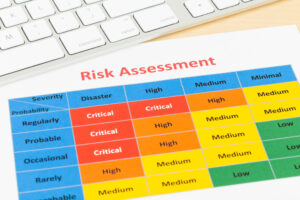 Risk assessments are completed so that you can identify possible causes of harm, the likelihood of that harm actually occurring given the safeguards already in place, and any further safeguarding measures needed to reduce that likelihood still further before an accident occurs.
A hazard is anything that can cause harm, e.g. a knife in catering. The potential severity of harm from our knife could be a minor cut needing a plaster if peeling potatoes with a small knife or a serious cut or worse if chopping with a large knife. The likelihood that an event of a particular severity will actually occur takes into account the control measures already in place, e.g., the use of a potato peeler instead, the use of a chain-mail glove when chopping, and proper training. The level of risk is the product of the likelihood and the potential severity.
A high level of risk is one where an event is very likely to occur and may cause death or serious injury/illness. A low level of risk is one where an event is unlikely or would result in a trivial or minor injury/illness with little or no time off work. A medium level of risk is in between these two, e.g. an event that is reasonably likely and could result in several days off work. By carrying out a risk assessment, you can direct attention and resources where they are most needed to prevent injuries or ill health.
The rating will vary depending on what the likely hood of that event actually happening. Usually, this is in a range of most unlikely, unlikely, likely and most likely, in other words, minor to major injuries.
Risks are then divided into three groups: low risk, medium risk, and high risk.
Low risk – unlikely to cause an injury, but action can still be taken to reduce this group more.
Medium Risk – Need to review control measures and do what you can to reduce the risk
High risk – Special control measures must be in place and training. This group is reviewed to try and reduce the risk where possible but this is not always the case.
The post Assessing Risks – High and Low risks appeared first on Online Health & Safety Training Courses | ProTrainings Europe.
]]>The post Risk Assessment and the 5 stages appeared first on Online Health & Safety Training Courses | ProTrainings Europe.
]]> Risk Assessment are carried out in a standard 5 stages. The HSE has a simple process to follow on risk assessing called the 5 steps of a risk assessment. We have put links in the student download area so you can find out more information. This process is standard with risk assessing and it works in all businesses no matter what their size or type. All the information in this section is as advised by the HSE so following it will ensure you are as compliant as possible.
The steps are:
Step 1 Identify the hazards
Step 2 Decide who might be harmed and how
Step 3 Evaluate the risks and decide on precautions
Step 4 Record your findings and implement them
Step 5 Review your assessment and update if necessary.
It is important when carrying out a risk assessment not to overcomplicate the process. In many organisations, the risks are well known and the necessary control measures are easy to apply.
When risk assessing for the first time you may have already taken reasonable precautions to avoid injury. If you run a small organisation and you are confident you understand what’s involved, you can do the assessment yourself. You don’t have to be a health and safety expert.
If you work in a larger organisation, you could ask a health and safety advisor or a health and safety representative to help you. If you are not confident, get help from someone who is defined as a competent person. In all cases, you should make sure that you involve your staff or their representatives in the process. They will have useful information about how the work is done that will make your assessment of the risk more thorough and effective. But remember, you are responsible for seeing that the assessment is carried out properly.
When thinking about your risk assessment, remember: a hazard is anything that may cause harm, such as chemicals, electricity, working from ladders, an open drawer. A risk is a chance, high or low, that somebody could be harmed by these and other hazards, together with an indication of how serious the harm could be.
A risk assessment involves assessing for all the hazards in the workplace, considering what could really harm people. For each of these hazards, you need to think about how serious could the harm be? Is it a cut finger or months off work with a back injury or musculoskeletal disorders. Who could be harmed and how likely is that? Do you need to do more to control the risks?
The post Risk Assessment and the 5 stages appeared first on Online Health & Safety Training Courses | ProTrainings Europe.
]]>